

CANADIAN PIPELINE COMPETENCY SYSTEM
SCHOOL OF ENERGY / Canadian Pipeline Competency System
The Canadian Pipeline Competency System (CPCS) provides an industry consensus-based set of requirements (i.e., theoretical knowledge, experience, expertise) for the technical functions associated with the lifecycle of a pipeline system.
WHAT IS COMPETENCY?
Competency can be considered as having three components, described in Figure 1:
| THEORETICAL KNOWLEDGE | EXPERIENCE | EXPERTISE |
|---|---|---|
| What does an individual know? | Does the individual apply their knowledge to real world situations? | How does the individual apply their knowledge and experience in a broad range of scenarios? |
Figure 1: Defining Competency
WHAT IS CPCS?
Demographic change and the evolution of industry regulation is driving a focus on competency management within the industry. To minimize the impact of these drivers and provide clarity regarding technical career paths, the Australian Pipelines and Gas Association’s (APGA’s) Pipeline Engineer Competency System was adapted by industry in 2021 for use in Canada. APGA is now working with Jiva Consulting to continue expanding adoption of CPCS in the Canadian market. The benefits of adopting CPCS are described below in Figure 2.

BENEFITS OF ADOPTING CPCS:
| COMPANY-SPECIFIC BENEFITS | INDUSTRY BENEFITS | INDUSTRY PERSONNEL BENEFITS |
|---|---|---|
| Ability to assess and identify technical competency gaps at both an individual and team level | More effective workforce retention and attraction | Increased understanding of potential career paths |
| Ability to optimize training and development plans | Improved quality and consistency of workforce technical competency | Opportunity to actively develop skills or improve skills in an essential industry |
| Effective succession planning for technical roles | Improved industry performance through more robust technical skills | Exposure to a greater range of technical information |
| Ability to support contractor selection |
Figure 2: Benefits of Expanded Use of CPCS
CPCS OVERVIEW:
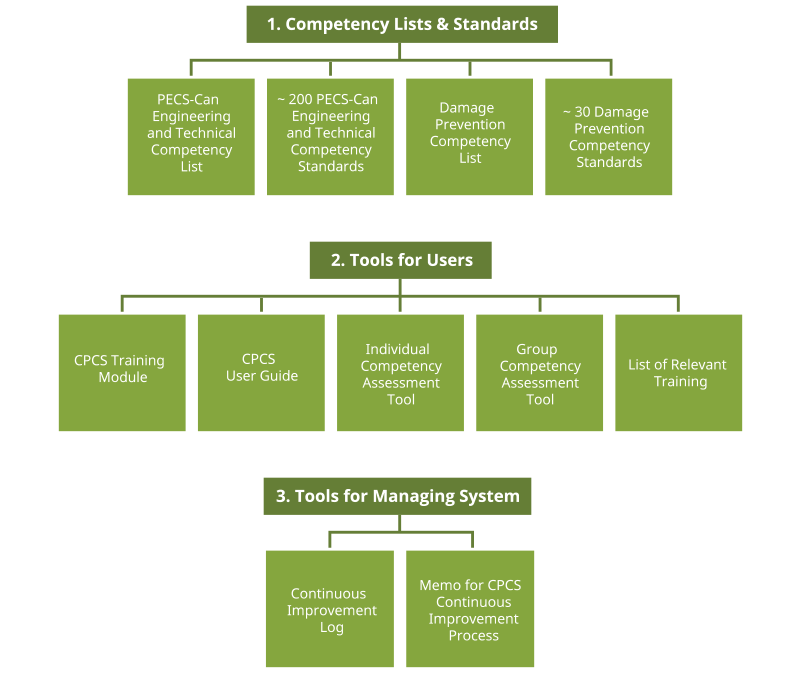
Figure 3: Components of CPCS
HOW CAN CPCS BE USED?
Applications of CPCS are described in Figure 4:
| INDIVIDUALS | ||||
|---|---|---|---|---|
| Career Planning | Demonstration of Current Competency | Establishing Current Development Goals | Future Development Goals | Tailored Job Applications |
| ORGANIZATIONS | ||||
|---|---|---|---|---|
| Succession Planning for Technical Roles | Demonstration of Meeting Regulatory Requirements | Clear Role Descriptions | Individual or Group Competency Assessment | Project Team Structure |
Figure 4: Application of CPCS
A FOCUS ON DAMAGE PREVENTION
Within the CPCS, a subset of competencies focused on prevention of damage to buried infrastructure is available. Aligned with regulations across multiple jurisdictions, the system provides the structure for a holistic damage prevention program that goes beyond the immediate field-based activities, to include areas such as public awareness efforts, which are essential for safety and effectiveness.
GET MORE INFORMATION – CONTACT US
For specific information on the Canadian Pipeline Competency System (CPCS), please refer to the contacts below:
Jeff Lecuyer
Business Development Specialist
jeff.lecuyer@jivaconsulting.com
(403) 993-7084
Ashley Lawson, P.Eng.
Project Manager
ashley.lawson@jivaconsulting.com
(403) 245-1140